Share
Space, Defence, & Security podcast
Powered by Access Hub
Latest episode

154. Ep.154 THE UNKNOWN MEN: Spies and Operations of R&AW | Dr Dheeraj Paramesha-Chaya
01:00:05||Season 1, Ep. 154India’s wars are not always fought on the battlefield.Behind the headlines, beyond diplomacy, exists a silent world of intelligence, covert operations, and strategic action. In this episode of the Space, Defence & Security Podcast, we explore the reality of Spies, India, and R&AW, the agency at the center of India’s external intelligence operations.Who are the “unknown men” often spoken about in connection with covert missions?How do intelligence operations actually work?And how has India’s approach to national security evolved in an increasingly complex geopolitical environment?This conversation moves beyond cinema and speculation to examine the strategic, operational, and psychological dimensions of intelligence work.🎙 Featuring Dr Dheeraj Paramesha-Chaya, Lecturer in intelligence and international security at the School of Criminology, Politics, and Law, University of Hull in UK, this episode provides a serious and informed perspective on one of the most discussed, yet least understood, aspects of national security.
More episodes
View all episodes
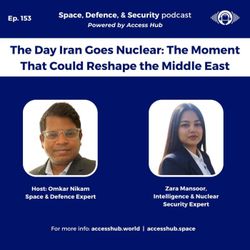
153. Ep.153 The Day Iran Goes Nuclear: The Moment That Could Reshape the Middle East - Zara Mansoor
44:00||Season 1, Ep. 153For decades, the world has tried to prevent Iran from developing nuclear weapons through sanctions, diplomacy, covert operations, and military pressure. But many analysts now believe Iran could reach nuclear weapons capability in the near future.If that happens, it will not just change Iran.It will change the Middle East.And it could reshape the global balance of power.In this episode, we speak with Zara Mansoor to explore the geopolitical, military, and strategic consequences of a nuclear Iran. We discuss Israel’s security doctrine, the possibility of a Middle East nuclear arms race, the role of the United States, China, and Russia, and what this means for the future of the global non-proliferation system.This is not a conversation about whether Iran will go nuclear.This is a conversation about what happens if it does.Link to Zara's newsletter.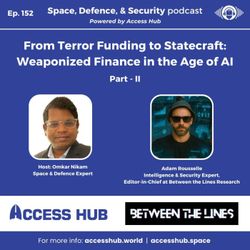
152. Ep.152 From Terror Funding to Statecraft: Weaponized Finance in the Age of AI - Part-II | Adam Rousselle
18:25||Season 1, Ep. 152Illicit finance is no longer a side issue, it is a core enabler of modern conflict, coercion, and gray-zone warfare.In this episode, we speak with Adam Rousselle, Intelligence and Security Expert, on how illicit financial networks power terror financing, sanctions evasion, organized crime, and state-driven hybrid operations worldwide.Moving beyond regional case studies, the discussion frames illicit finance as a global security architecture problem, shaped by fragmented regulation, data silos, and slow institutional response. Adam outlines a three-tier framework to explain how these networks are built, how money flows through them, and why they remain resilient.We also examine where AI is genuinely changing the game in counter-illicit finance, network analysis, anomaly detection, pattern recognition, and where its limits remain without strong data, governance, and human judgment.This isn’t about compliance. It’s about financial systems as battlefields, and why counter-illicit finance is now inseparable from national security and geopolitics.For deeper insights on illicit finance and global security, subscribe to BTL Research by Adam Rousselle.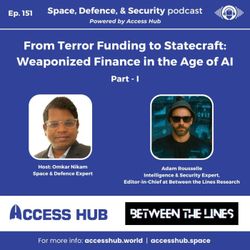
151. Ep.151 From Terror Funding to Statecraft: Weaponized Finance in the Age of AI - Part-I | Adam Rousselle
27:42||Season 1, Ep. 151Illicit finance is no longer a side issue, it is a core enabler of modern conflict, coercion, and gray-zone warfare.In this episode, we speak with Adam Rousselle, Intelligence and Security Expert, on how illicit financial networks power terror financing, sanctions evasion, organized crime, and state-driven hybrid operations worldwide.Moving beyond regional case studies, the discussion frames illicit finance as a global security architecture problem, shaped by fragmented regulation, data silos, and slow institutional response. Adam outlines a three-tier framework to explain how these networks are built, how money flows through them, and why they remain resilient.We also examine where AI is genuinely changing the game in counter-illicit finance, network analysis, anomaly detection, pattern recognition, and where its limits remain without strong data, governance, and human judgment.This isn’t about compliance. It’s about financial systems as battlefields, and why counter-illicit finance is now inseparable from national security and geopolitics.For deeper insights on illicit finance and global security, subscribe to BTL Research by Adam Rousselle.
150. Ep.150 Joint Warfare Reality: How Weapons Are Selected for Air-Land-Sea Integration - Part-II | Sqn Ldr Shailesh Pol
57:37||Season 1, Ep. 150Joint warfare is not about individual platforms. It’s about who owns the mission, who controls the air, and who controls the kill chain.As India moves toward integrated theatre commands, the logic of warfare is undergoing a fundamental shift. Weapons that perform exceptionally within a single service often struggle when exposed to the realities of Air-Land-Sea joint operations. The difference between success and failure is no longer defined by firepower alone, but by sensors, data links, interoperability, and decision-making timelines.In this two-part episode, Sqn Ldr Shailesh Pol, a specialist in Air Defence, Counter-UAS, and aerial weapons, breaks down the realities of modern joint warfare from an operational perspective. This is not a doctrinal discussion. It is a candid examination of how weapons are actually evaluated, selected, integrated, and employed when multiple services fight as one.The conversation explores:How weapon selection fundamentally changes when the Air Force supports an Army-led campaign or a Naval task forceWhose requirement truly drives decisions in joint operations, the platform owner or the mission ownerWhy some weapons that look ideal on paper become liabilities once joint integration beginsThe critical role of sensors, networks, and control of targeting in determining weapon effectivenessWhat is harder to align in real operations: doctrine, communications, or decision-making speedWho truly controls the air in an army-led battlefieldHow joint forces counter non-conventional and non-standard threatsWhich interoperable systems enable success across Army, Navy, and Air Force operationsWhat policymakers and industry continue to underestimate about joint weapon integrationThis is essential viewing for military professionals, defence industry leaders, policymakers, analysts, and anyone seeking to understand how future conflicts will be fought, not in theory, but in reality.
149. Ep.149 Joint Warfare Reality: How Weapons Are Selected for Air-Land-Sea Integration - Part-I | Sqn Ldr Shailesh Pol
36:08||Season 1, Ep. 149Joint warfare is not about individual platforms. It’s about who owns the mission, who controls the air, and who controls the kill chain.As India moves toward integrated theatre commands, the logic of warfare is undergoing a fundamental shift. Weapons that perform exceptionally within a single service often struggle when exposed to the realities of Air-Land-Sea joint operations. The difference between success and failure is no longer defined by firepower alone, but by sensors, data links, interoperability, and decision-making timelines.In this two-part episode, Sqn Ldr Shailesh Pol, a specialist in Air Defence, Counter-UAS, and aerial weapons, breaks down the realities of modern joint warfare from an operational perspective. This is not a doctrinal discussion. It is a candid examination of how weapons are actually evaluated, selected, integrated, and employed when multiple services fight as one.The conversation explores:How weapon selection fundamentally changes when the Air Force supports an Army-led campaign or a Naval task forceWhose requirement truly drives decisions in joint operations, the platform owner or the mission ownerWhy some weapons that look ideal on paper become liabilities once joint integration beginsThe critical role of sensors, networks, and control of targeting in determining weapon effectivenessWhat is harder to align in real operations: doctrine, communications, or decision-making speedWho truly controls the air in an army-led battlefieldHow joint forces counter non-conventional and non-standard threatsWhich interoperable systems enable success across Army, Navy, and Air Force operationsWhat policymakers and industry continue to underestimate about joint weapon integrationThis is essential viewing for military professionals, defence industry leaders, policymakers, analysts, and anyone seeking to understand how future conflicts will be fought, not in theory, but in reality.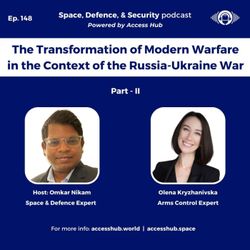
148. Ep.148 The Transformation of Modern Warfare in the Context of the Russia-Ukraine War - Part-II | Olena Kryzhanivska
26:38||Season 1, Ep. 148The Russia-Ukraine war has stripped away long-held assumptions about military power, exposing what works, what fails, and what adapts under pressure.In these episodes, Olena Kryzhanivska examines the shifts that defined 2025: the growing dominance of low-cost, scalable weapons, the declining advantage of legacy platforms, and the speed at which warfare now evolves through constant battlefield feedback.We discuss Ukraine’s move to open arms exports, its implications for the global defense market, and how deterrence and escalation are being reshaped one step at a time.This is not theory, it’s the blueprint of how future wars will be fought.For more insights, follow Olena’s essential reporting at Ukraine’s Arms Monitor on this link.